
PU Foam Scrap: High-Quality Polyurethane Foam Scraps for Rebonding, Filling, and Recycling
Low-grade foam scraps can create more problems than savings. Mixed colors, dust, moisture, fabric, glue, or unknown additives can reduce the value of an entire load. For buyers of PU foam scrap, the real goal is not simply low price—it is clean, consistent, usable material.
PU foam scrap is leftover flexible polyurethane foam generated during cutting, trimming, and fabrication. High-quality foam scraps are usually clean, dry, and separated by material type or grade. They can be reused in shredded foam filling, rebonded foam, carpet underlay, furniture padding, and other recycling applications, depending on the specification and local requirements.
What Is PU Foam Scrap?
PU foam scrap is leftover flexible polyurethane material produced when larger foam blocks, sheets, cushions, mattress layers, or custom components are cut to shape. In a foam factory, this material may come from edge trimming, CNC cutting, slicing, contour cutting, or other fabrication processes.
The key point is that not all foam scraps are equal. Clean production offcuts are very different from post-consumer foam waste collected from old furniture or mattresses. Factory trim often has a known material source, while mixed post-consumer material may contain fabric, adhesives, dirt, metal, or other contamination.
At Jiangyuan Foam, our main business is manufacturing flexible polyurethane foam and custom components for furniture and mattress customers. Because we carry out foaming, slicing, CNC cutting, lamination, and profiled shaping in-house, production naturally generates some trim foam and offcuts. Our environmental policy states that production waste is collected separately, with suitable material sent for recycling or further use rather than simply discarded.
For a buyer, this distinction matters. If your application depends on consistent material, you should ask whether the scrap foam is:
- post-industrial or post-consumer,
- virgin PU production trim or mixed material,
- clean and dry,
- sorted by type or color,
- separated from fabric and adhesive,
- suitable for shredding,
- suitable for rebonding,
- or intended only for lower-value recycling.
The Polyurethane Foam Association notes that flexible polyurethane foam manufacturing scrap is widely recycled and that post-industrial foam scrap is commonly used in bonded carpet cushion and other applications.
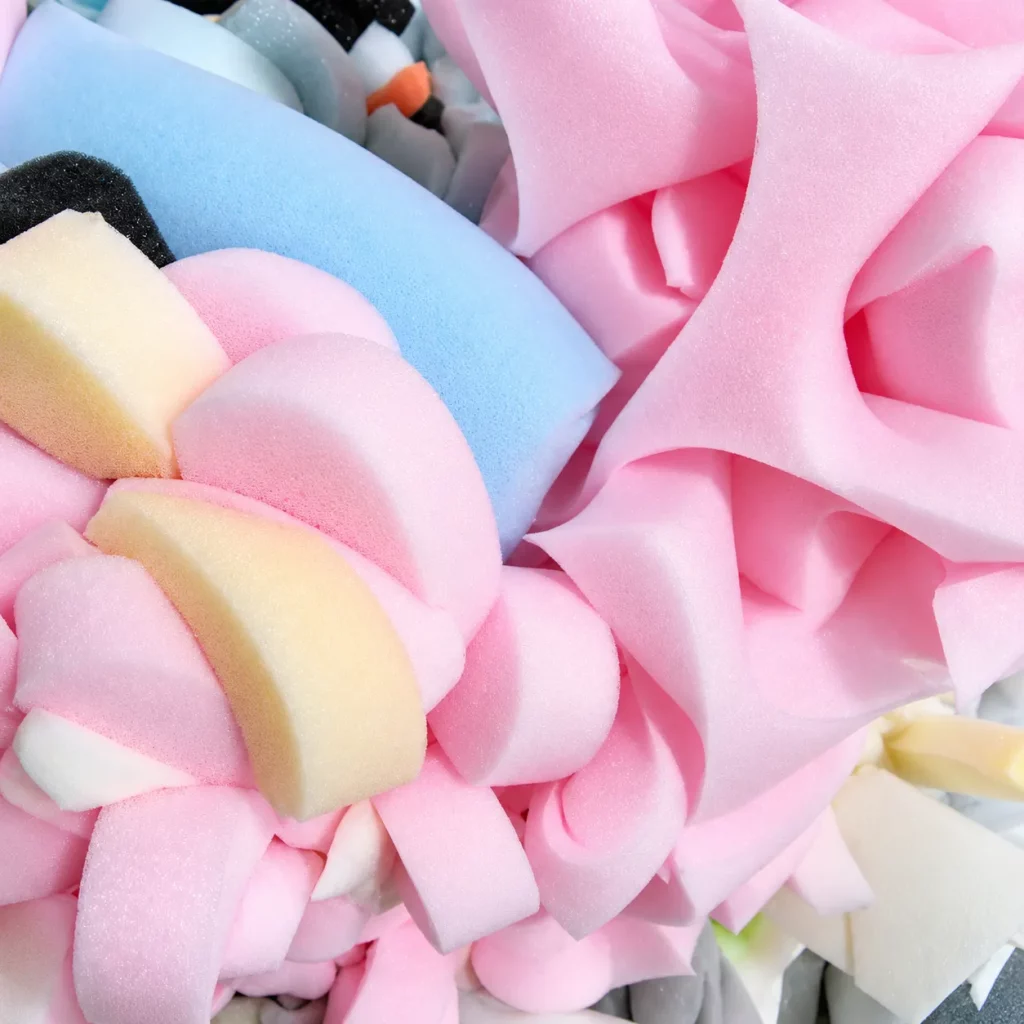
Where Do High-Quality Foam Scraps Come From?
High-quality foam scraps usually come from controlled factory processes.
When a manufacturer cuts a large foam block into seat cores, mattress layers, or custom shapes, some material remains around the finished part. This PU trim may still be structurally sound even though its size or shape is no longer useful for the original order.
Common sources include:
- block slicing,
- mattress layer cutting,
- sofa cushion trimming,
- CNC contour cutting,
- profiled component shaping,
- sheet size adjustment,
- pillow or seating production,
- and edge trimming from finished foam parts.
This is why clean factory offcuts can be attractive to a recycling buyer. The material may never have entered consumer use and can often be identified by foam type, density range, or production source.
For example, a furniture sponge factory may generate furniture scrap sponge from sofa seat production. A mattress line may produce mattress sponge trim. Memory foam processing may create memory foam scrap, while HR material may create high resilience offcuts.
At Jiangyuan, our primary foam lines include standard PU foam, HR foam, memory foam, high-density foam, and custom-cut components. Any foam scrap inquiry should therefore begin with the actual available material, not a generic claim that every bale contains one uniform grade.
That is especially important for buyers looking for high-quality PU foam scrap. “Grade A” should not be treated as a universal technical standard unless both buyer and supplier define exactly what it means.
A practical grade definition may include:
- material type,
- color range,
- density range,
- piece size,
- moisture condition,
- contamination limit,
- fabric content,
- adhesive content,
- and whether memory foam or conventional PU is mixed in.
How Is Polyurethane Foam Scrap Graded?
There is no single worldwide grading system for polyurethane foam scrap. Suppliers and buyers often use commercial labels such as Grade A, Grade B, clean trim, mixed color, white scrap, memory foam scrap, or rebond-grade material.
Because those labels can mean different things, buyers should request a clear quality grade evaluation.
A useful grading framework may look like this:
| Grade Factor | Higher-Quality Scrap | Lower-Value Scrap |
|---|---|---|
| Cleanliness | Clean and dry | Dust, glue, fabric, dirt |
| Source | Factory trim | Mixed or unknown source |
| Material | Sorted PU or memory foam | Mixed foam types |
| Moisture | Dry | Damp or wet |
| Piece size | Larger, usable pieces | Very small mixed particles |
| Contamination | Minimal | Visible foreign material |
| Color | Sorted or controlled | Fully mixed |
| Traceability | Known production source | Unknown |
| Recycling value | Higher | Lower |
A buyer asking for grade foam should therefore avoid relying on photographs alone.
Request a specification sheet or written confirmation. If the order is large, a pre-shipment sample may be useful.
The phrase foam scrap with no contamination is valuable only when “contamination” is defined. Does it mean no fabric? No glue? No plastic film? No water? No metal? No EVA? No latex?
Be specific.
If you are purchasing waste PU foam scrap bulk, the contract should ideally state what foreign material is acceptable and what is not.
What Can PU Foam Scrap Be Used For?
Clean PU foam scrap can have several second-life applications.
One of the best-known uses is rebonded foam. In this process, scrap polyurethane foam is shredded into smaller pieces, mixed with a bonding system, compressed, cured, and formed into a dense recycled foam product.
The Polyurethane Foam Association explains that flexible polyurethane foam scrap is mechanically recycled into bonded carpet cushion, often called rebond. It also reports that bonded carpet cushion typically contains a very high proportion of recycled material. Polyurethane Foam Association
Common end uses include:
- carpet padding and carpet underlay,
- furniture padding,
- gym mats,
- packaging pads,
- underlayment,
- sound-control products,
- pet bedding,
- shredded filling,
- and selected industrial cushioning applications.
Another route is shredded foam.
Larger foam scraps can be cut or shredded into smaller pieces for filling applications. Depending on the grade, the material may be used in pillows, cushions, pet beds, bean bags, or other soft products.
However, buyers should not assume all scrap is suitable for shredded foam for pillow fillings. If the final product has direct human contact, the material source, cleanliness, formulation, odor, and compliance requirements become more important.
A third route is the production of re-bonded foam.
Rebond is useful where a higher-density recycled material is needed, such as carpet underlay or some support layers. Compared to virgin foam, rebond often offers a different feel and mechanical profile. It should not be treated as a direct substitute for every virgin foam application.
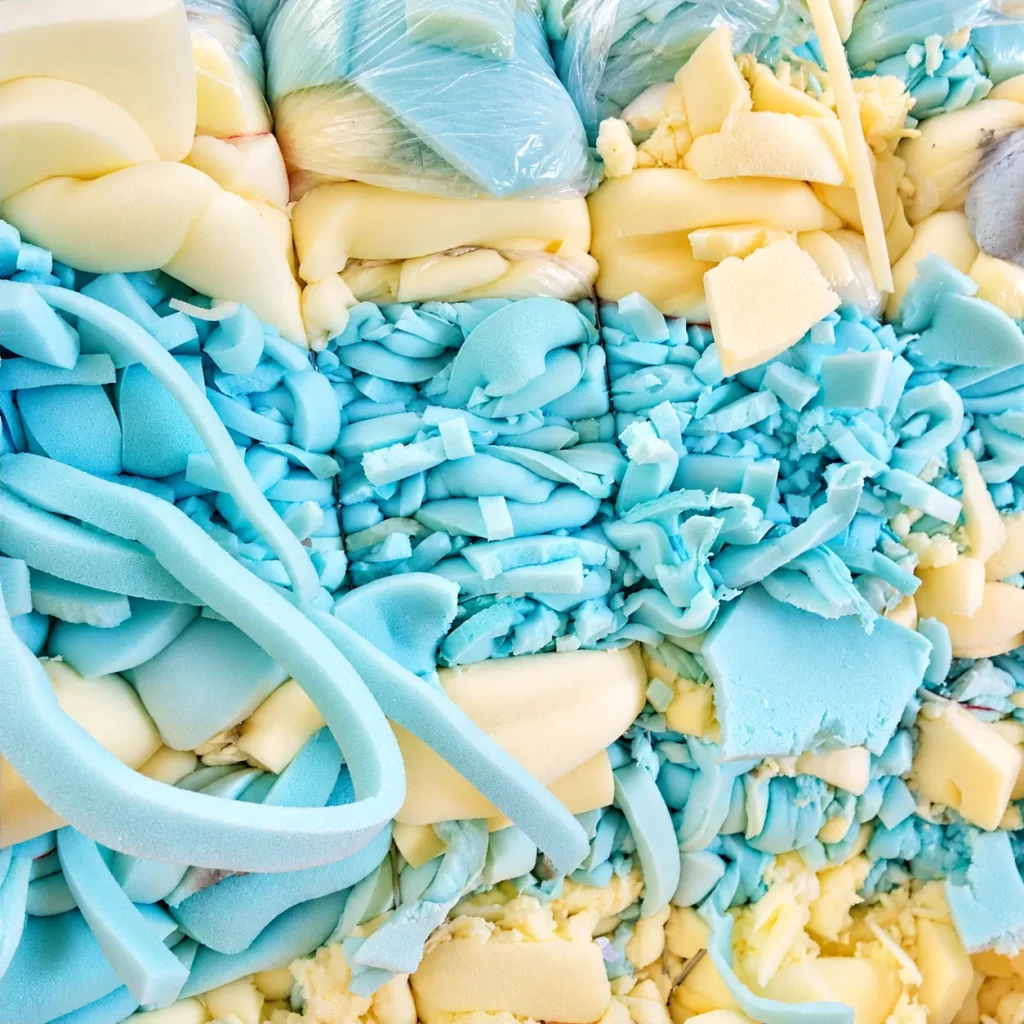
What Is the Difference Between Foam Scraps, Shredded Foam, and Rebonded Foam?
These terms are related, but they are not interchangeable.
Foam Scraps
Foam scraps are the original leftover pieces created during production or collected after use. They may be large offcuts, strips, edge trim, or irregular pieces.
Shredded Foam
Shredded foam scraps are pieces that have already been mechanically cut into smaller particles.
They are commonly used as loose filling.
Rebonded Foam
Foam rebonded material is made by taking shredded scrap, adding binder, compressing it, and curing it into a new block or sheet.
The result is much denser and more compact than the original scrap.
| Material | Form | Typical Use |
|---|---|---|
| PU foam scrap | Loose offcuts | Recycling input |
| Shredded foam | Small pieces | Pillow/cushion filling |
| Rebonded PU foam | Dense bonded block/sheet | Carpet underlay, padding |
| Memory foam scrap | Slow-rebound offcuts | Filling or recycling |
| Trim foam | Factory cutting leftovers | Rebonding or shredding |
This distinction matters when requesting a quote.
If you ask a supplier for “foam waste,” they may offer loose scraps.
If you need ready-to-use filling, ask for shredded foam.
If you need dense recycled sheet material, ask for rebonded PU foam.
Why Do Density, Rebound, and Cleanliness Matter?
Many buyers focus first on price PU foam scrap, but technical quality often has a larger impact on final yield.
Three factors are especially important.
Density
Foam density affects the amount of polymer material in the foam and often influences how the material behaves during shredding or rebonding.
Mixed-density scrap can produce a less predictable recycled output.
If a buyer needs a controlled density foam input, the supplier should explain whether the scrap is separated by density or sold as mixed material.
For high density recycling applications, higher-density trim may be more valuable, but the correct grade depends on the final product.
Rebound
Foam with higher resilience behaves differently from slow rebound sponge or memory foam.
A bale containing high resilience and slow rebound material may not process the same way as a bale containing only conventional flexible PU.
That is why rebound characteristics matter.
Cleanliness
Cleanliness may be the most important factor of all.
A clean bale is easier to process.
Wet or dirty material can create odor, storage, handling, and production problems. Fabric, plastic, metal, wood, or adhesive contamination can damage shredding equipment or lower product quality.
For a serious recycling buyer, “clean and dry” should be a basic requirement.
How Is Foam Waste Compressed and Packed for Export?
Foam has one major logistics problem: volume.
It is light, but bulky.
For export, loose foam scraps may therefore be compressed into a bale to improve loading efficiency.
A typical process may include:
1. sorting the PU scrap,
2. removing visible contamination,
3. loading material into a baler,
4. compressing it,
5. wrapping or strapping the bale,
6. weighing each bale,
7. labeling the batch,
8. and loading the container.
The Polyurethane Foam Association notes that flexible foam can be compressed significantly for transportation because much of its cellular volume consists of air. Polyurethane Foam Association
For scrap material, exact compression ratios depend on the foam type, piece size, density, and baling equipment.
Some orders are shipped compressed in bales. Others may use bags or compressed bundles.
Before ordering, confirm:
- approximate bale weight,
- bale dimensions,
- net and gross weight,
- number of bales per container,
- wrapping method,
- loading method,
- moisture protection,
- and whether material can recover after unpacking if needed.
The phrase “foam bales” sounds simple, but logistics can change the actual wholesale price after freight is included.
For international procurement, container efficiency should be calculated together with the material price.
What Should Buyers Check Before Purchasing PU Foam Scrap?
If you are sourcing from a new supplier, use a written checklist.
Material Source
Ask whether the material is:
- post-industrial,
- post-consumer,
- production trim,
- furniture scrap,
- mattress scrap,
- memory foam scrap,
- or mixed PU scrap.
Foam Type
Confirm whether the load contains:
- conventional PU,
- HR foam,
- memory foam,
- slow rebound sponge,
- filter foam scrap,
- bra foam scrap,
- or mixed material.
Do not assume “PU foam scrap” means one composition.
Cleanliness
Ask whether the load is free from:
- metal,
- fabric,
- plastic,
- paper,
- wood,
- glue-heavy laminated parts,
- water,
- oil,
- dirt,
- mold,
- and unknown waste.
Moisture
Foam scrap should generally be clean and dry before baling and storage.
Wet foam increases weight without adding useful material and can create odor or hygiene problems.
Size
If the buyer uses shredding equipment, piece size may not be critical.
If the scrap is used directly as filling or for further manual processing, size can matter.
Photos and Samples
For PU foam scrap wholesale, ask for current batch photos rather than old catalog images.
If possible, request a sample.
Documentation
Depending on the market and application, buyers may ask for:
- invoice,
- packing list,
- origin information,
- composition statement,
- material safety data sheets where relevant,
- and export documents.
The exact paperwork depends on the destination and whether the material is legally classified as product, secondary raw material, recyclable scrap, or waste.
This point must be checked with the importer and local authorities before shipment.
How Does Recycling Foam Scrap Support a Circular Economy?
The main environmental value of foam scrap recycling is simple: usable material stays in circulation longer.
Instead of sending every offcut to landfill, clean scrap can become an input for another product.
This supports a more practical circular economy.
The Polyurethane Foam Association states that flexible polyurethane foam has a strong recycling record, particularly for post-industrial material. It also notes that large amounts of scrap are mechanically recycled into bonded carpet cushion rather than discarded. Polyurethane Foam Association
Mechanical recycling is currently one of the most established routes.
The process typically involves:
scrap collection → sorting → shredding → bonding → compression → curing → slicing
That creates a new recycled foam product.
Chemical recycling also exists, but it is more complex because flexible polyurethane foam is a thermoset material. Researchers continue to work on methods that break the material back into chemical feedstocks for new polyurethane production. Polyurethane Foam Association
At Jiangyuan, our own sustainability approach focuses on responsible production-waste handling. Suitable scrap is collected separately and recycled through specialized channels, while selected foam offcuts may be made available for further use.
This is more realistic than claiming every piece of foam waste can automatically become new virgin-quality foam.
Recycling routes depend on the material.
How Do You Choose a Reliable PU Foam Scrap Supplier?
A reliable PU foam scrap supplier should provide more than a low price.
For repeat importers, the most important factor is consistency.
Ask these questions before purchasing:
- Is the scrap generated in your own factory?
- What foam types are included?
- Is the material sorted?
- Is it clean and dry?
- What is the approximate density range?
- Are memory foam and standard PU mixed?
- What is the average bale weight?
- How is the material compressed?
- Can you provide current batch photos?
- Can you provide a sample?
- What contaminants are excluded?
- What export documents can you provide?
A direct factory source may have an advantage because it knows where the material came from.
Jiangyuan Foam operates its own polyurethane foam production and fabrication processes. Our core business is not trading random scrap from unknown sources. We manufacture flexible foam and custom components for furniture and mattress industries, so any available trim material originates from defined production processes.
That allows buyers to discuss the source more clearly.
For example, a customer may request:
- standard flexible PU foam scrap,
- HR trim,
- memory foam scrap,
- mixed-color clean scraps,
- larger offcuts,
- or material for shredding and rebonding.
Availability will vary by production schedule.
For this reason, we recommend confirming the current batch before placing a bulk order.
You can learn more about our polyurethane foam manufacturing capabilities, explore our bulk foam blocks and sheets, or review our [environmental responsibility practices.
If your goal is not scrap but a finished recycled product, you can also ask about rebonded foam and other foam materialsor send your target density and application through our custom foam project inquiry page.
FAQ
What is PU foam scrap?
PU foam scrap is leftover flexible polyurethane foam generated during cutting, trimming, shaping, or fabrication. It may include strips, edge trim, offcuts, or irregular pieces from furniture, mattress, or component production.
Can foam scraps be recycled?
Yes. Many clean flexible polyurethane foam scraps can be mechanically recycled. A common route is shredding and bonding the scrap into rebonded foam used for carpet cushion and other padding applications.
What is Grade A PU foam scrap?
There is no single universal Grade A standard. In trade, it often means clean factory trim with low contamination, good dryness, and relatively consistent material. Buyers should define the exact grade requirements in writing.
Can memory foam scrap be mixed with normal PU foam scrap?
It can be mixed for some recycling applications, but this depends on the buyer's process. Memory foam has slower rebound and different physical behavior, so buyers should confirm whether mixed material is acceptable.
How is PU foam scrap packed for export?
It is commonly compressed into bales to reduce shipping volume. Bale weight, dimensions, compression level, wrapping, and container loading depend on the material and baling equipment.
Can foam scrap be used for pillow filling?
Selected clean material may be shredded for filling applications, but suitability depends on the foam source, cleanliness, formulation, odor, and local product requirements. Buyers should not assume all scrap is suitable for direct-contact products.